
A single spreadsheet can be the difference between a response on your stock in under 24 hours or not receiving one at all. Here we cover what you should send on your clearance stock spreadsheet.
In short: product names, barcodes, images, descriptions, RRP or MSRP, grade and condition, quantity, the quantity per size, and an indication of your target price.
Who are we?
We are a small clearance team with 40+ years of experience in the trade. This is part of an article series covering the most common questions we get asked.
The columns
| Column | What we need | Why it changes the offer |
|---|---|---|
| Product name | Name of product | Lets us identify the item and find comparable sales for it. |
| Barcode | EAN or UPC | Without this it is hard for us to find the exact product and price it against real sales. |
| RRP/MSRP | The recommended retail price for each product | This benchmark against the full high street price calibrates the value of the bid. It is one of the first things we research, and with it we can place a bid faster. |
| Image | An image of each product | Especially important for less well known brands, where the clearance buyer is not familiar with the product. |
| Grade | New / used / damaged / missing box | Without knowing the condition of the item we cannot value it. |
| Target price | Target price for each line | This allows us to quickly see if we are in the right ballpark, or if the conversation is not going to be productive for either party. |
| Quantity | How many units of that product | Volume changes both the price we can pay and whether the parcel is worth handling at all. |
| Quantity per size | If clothing or shoes, we need to see what the quantity is for each size | A broken size curve is worth far less than a complete one, even at the same unit count. |
Why more detail is better
Imagine you are selling your house. If you advertise the house online as 'house for sale' and show minimal photos or details, someone might buy the house, but they would pay much less than if they had full details.
Likewise in clearance, whenever we lack details we have to build a larger margin for error into our buy price. So in general, the more information you share, the better the price we can give.
Two comparison lists side by side
Here we share two examples of offers we received, anonymised and with some details changed, to give an idea of what makes an offer easier or harder to review.
Example 1: an offer which is difficult to evaluate
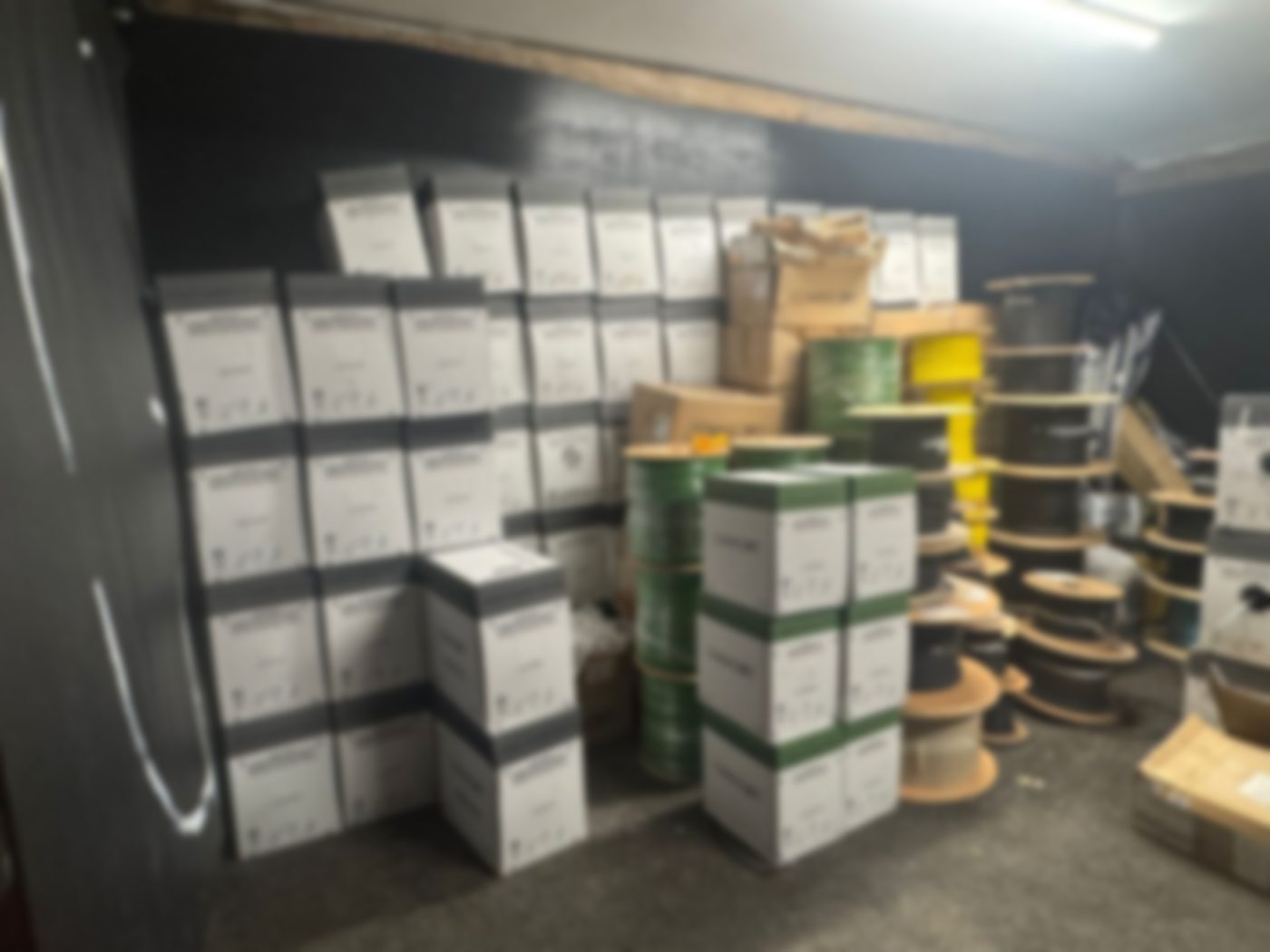
This came with the following text:
- 74 boxes of REDACTED. Some are full and some are part-used.
- 6 boxes of REDACTED.
- 8 boxes of REDACTED, with a mixture of full and part-used boxes.
- Approx. REDACTED.
- Approx. 26 cartons of REDACTED.
- Approx. 50 REDACTED.
- Additional REDACTED.
- Target price 50% of retail.
This offer is hard to evaluate. The quantities are not exact, the conditions are mixed without exact quantities for each, and we have a single photo of all the stock rather than a spreadsheet with a photo of each item, so we would need to pair them up by eye. We also lack any pricing comparison points for each of the lines. 50% of retail is extremely high for clearance, even if the stock is new rather than part-used.
All in all, it would take a lot of time even to quote on a deal like this, and in this case we passed on the offer.
Example 2: an offer which is easier to evaluate
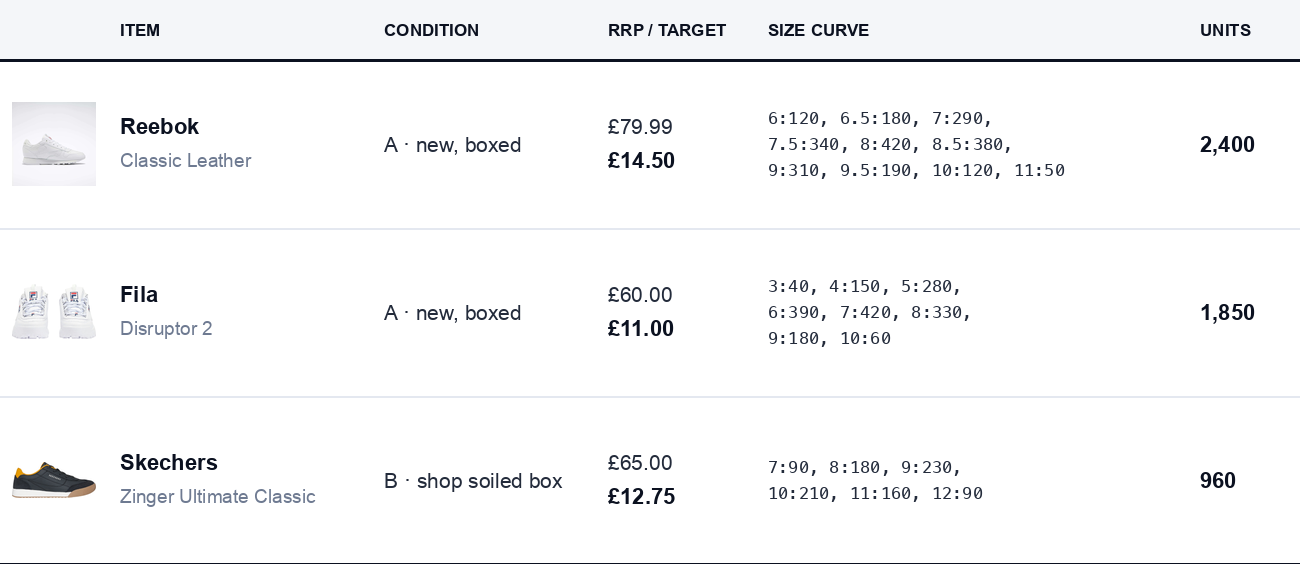
This is the same kind of information in a form we can actually price. Every line carries an image, the brand, the condition, the RRP and the quantity, and the size curve is written out size by size rather than left as a total. That lets us research comparable sales line by line and come back with a price per line instead of one number for the whole pile.
The mistakes we see most
- You send us a list of photos with no context or details, over WhatsApp.
- Unrealistic recovery expectations, particularly for less well known brands.
- Size curves missing on clothes or shoes.
- No images on items.
Restrictions: tell us up front
If you have restrictions on sale, these need to be shared early on.
Please note that sale restrictions can change the value of your clearance by 10x or more. For example, if you only want your clearance stock sold in Africa, you might go from recovering 10% of retail to 1% or 2%. We have covered the trade-offs in how to sell clearance stock without devaluing your brand.
Speak to us
Please use our contact form, WhatsApp me directly on +44 7348 950 325, or email me at ethan.horsfall@diracgroup.com.